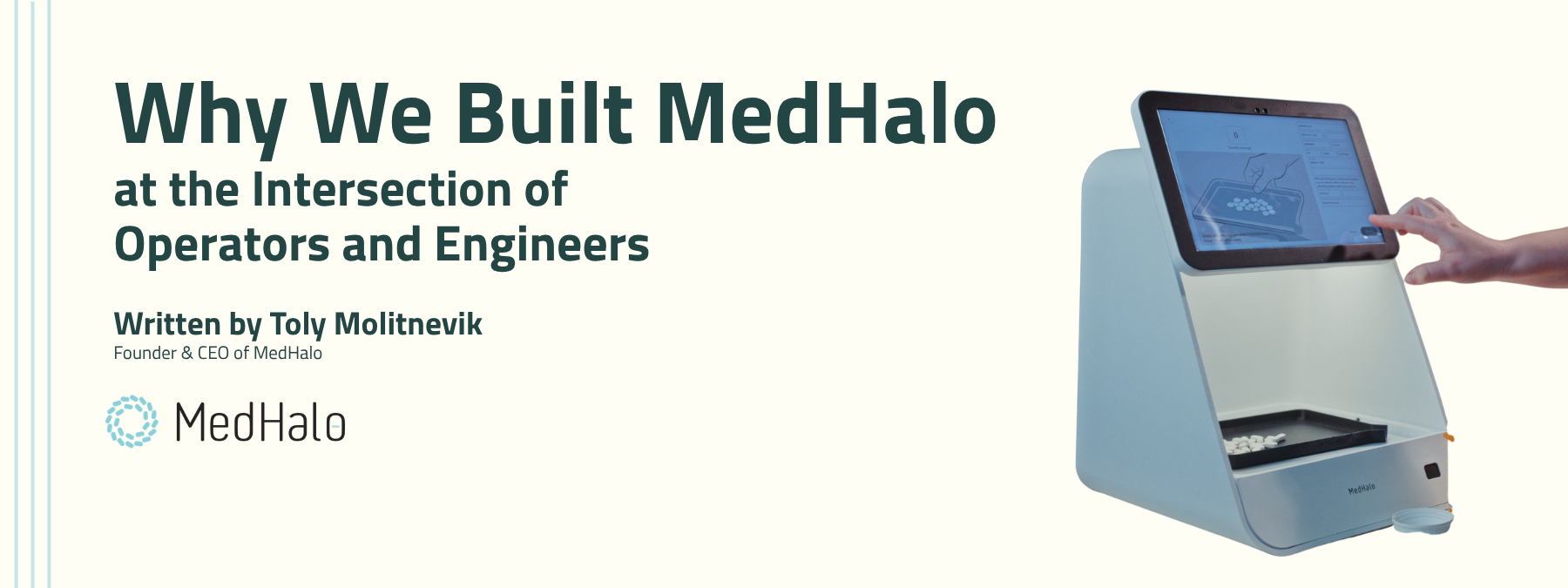
Why We Built MedHalo at the Intersection of Operators and Engineers
October 14, 2026
Fifteen years as a senior living operator teaches you to pay attention to pain. Not to manage it or explain it away, but to treat it as information. The things that hurt repeatedly, that eat time and create risk and keep operators up at night, are the things worth solving. That discipline is how All Seasons grew from one resident and a driveway sensor into a community testing ground for some of the most practical technology in senior living. And it is exactly how MedHalo came to exist.
I started in 2011. My first resident, I was the first caregiver, with no prior experience in caregiving at all. I remember thinking about how I would want to be treated if I were 91 and had just had a stroke. He was especially prone to falls. I could not stand the thought of him getting up and me not knowing, not being there. So I went on Amazon and bought a driveway sensor and put it near him.
That is where it started. Not with a product vision or a technology roadmap. With a resident I did not want to fall.
Over the years that followed, I learned to use technology the same way every time. Find the pain first, then find the tool that solves it. We have a saying at All Seasons that captures the whole philosophy: we load the dishwasher fast so we can sit with a resident slow. Identify what does not need a human being. Use technology for that. Give the human back the time to do what only a human can do.
The MedHalo story begins from exactly that place. A few years ago I was working with a group of technologists on smart glasses, exploring the idea of real-time guidance for med techs during the medication pass. During that work, we had a medication error. Every community has them. And in the moment after that error, I had a thought I could not let go of.
I wish something could look into that med cup and tell me exactly what is inside it.
That was the whole idea. Not a feature, not a platform, not a system. One question. If a phone can identify a plant from a photograph, why could a camera not read a doctor's order? Why could it not see the medication in a med tech's hand, transcribe the label, verify the dose against the active order, and confirm at the last possible moment before it reaches a resident: yes, this is the right medication for this person, and yes, it is now documented. Automatically. Without a form to fill out or a binder to update or a count to reconcile by hand at the end of a long shift.
I was already working informally with technologists who used All Seasons as a testing ground for new ideas. When the concept for MedHalo became clear, I brought it to several of them and they wanted in immediately. The team that came together included people who had built hardware and intelligence systems at Intel and Samsung, who had led healthcare platforms from the ground up, and who had deep expertise in computer vision applied to real-world physical environments. They understood the engineering problem right away, and they understood something else that mattered just as much: the solution had to fit the workflow that already existed on the floor, not demand a new one.
That last point is not a small consideration. Senior living medrooms are not controlled laboratory environments. They are busy, high-stakes spaces where the people doing the work are already carrying more than they should have to. A verification system that added friction, required new habits, or put another screen between a med tech and her residents would fail regardless of how technically sound it was. The solution had to be fast, accurate, and almost invisible in its demands on the caregiver.
That combination, deep operator knowledge of the problem and the people, paired with genuine engineering excellence in computer vision and hardware, is what MedHalo required to become real. Neither side could have built it alone. Operators without the engineering capability would have produced good intentions and limited results. Engineers without the operator context would have built something technically impressive that no one on the floor would actually use.
The principle has not changed since the driveway sensor. Use pain to find what technology can solve, so the humans in the room are free to do the thing only humans can do.
The highest use of technology is multiplying the human connection. That is what MedHalo is built around, not because it makes for a good mission statement, but because it is the only reason I would ever build a technology company in the first place.