What 'The New Verification Layer' Actually Means
October 28, 2026
I use the phrase "verification layer" often enough that I want to stop and explain what it actually means in practice. Not in technical language, not in marketing language, but in the plain terms of what happens during a medication pass when MedHalo is part of the workflow.
Start with what was there before.
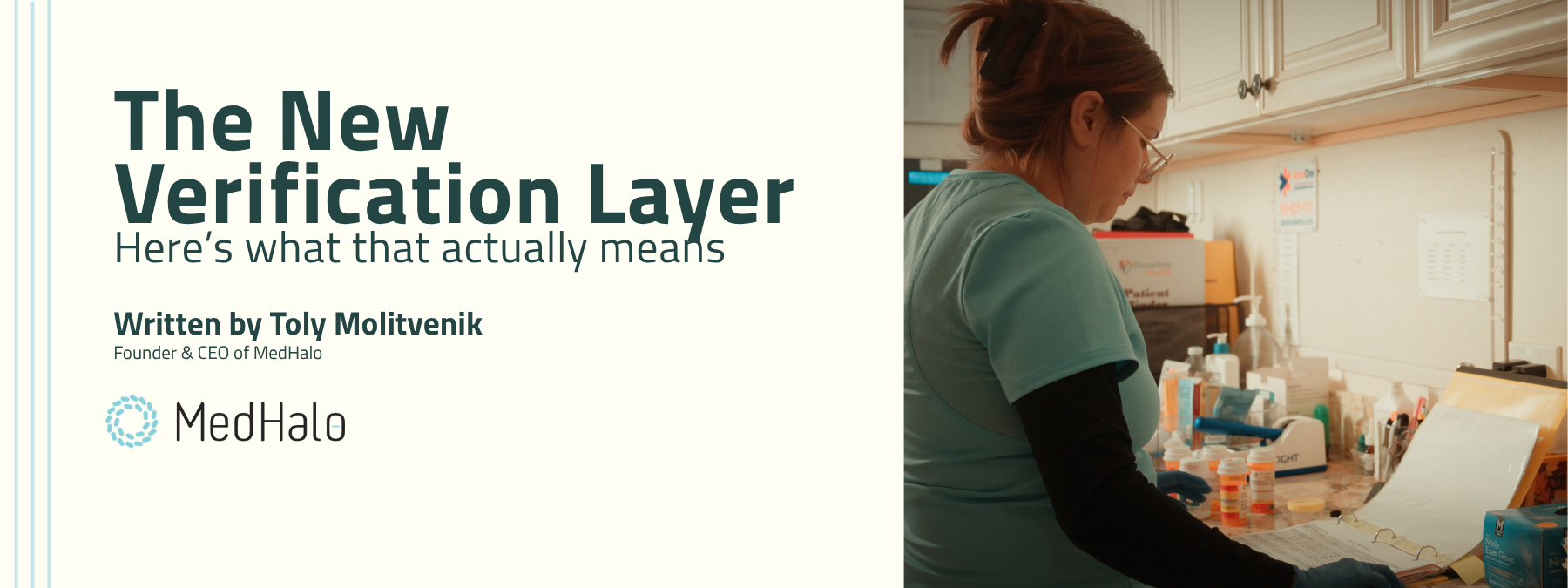
A med tech approaches the medication cart. She has a resident's medication profile open in the EMAR on a tablet or workstation nearby. She pulls a bubble pack or a bottle, checks it against the profile by eye, confirms the resident's identity, and administers the dose. She documents what happened, either in real time or at the end of the pass. That process, done carefully, is as safe as the person doing it. Done under pressure, at the end of a long shift, with an interrupted workflow and a cart that's running behind, it is vulnerable in ways that training and good intentions cannot fully address.
Now here is what changes with MedHalo.
The kiosk sits at the point of care, integrated into the existing workflow. The med tech places the bubble pack or bottle inside. In under a second, optical character recognition reads the label and the printed medication order. Computer vision confirms what the medication is, who it belongs to, and what the active order requires. The physical dose is matched against the EMAR record in real time. If everything matches, the pass proceeds. If something does not match... a changed dosage that wasn't updated in the physical supply, an expired medication, a duplicate from a second pharmacy, a dose that doesn't align with the current order... MedHalo flags it before the medication reaches the resident.
The documentation writes itself. Every scan is logged automatically, with a timestamp and a verification record, without the med tech entering anything by hand. Pill counts update in real time. Controlled substance counts, daily counts, and shift counts are maintained automatically. What used to require manual reconciliation at the end of a shift happens continuously, in the background, without anyone managing it.
The med tech's workflow does not change in any meaningful way. She is still the one administering medications, still the one with clinical judgment and resident knowledge that no system replicates. What changes is that the confirmation step, the moment of matching physical medication to active order, no longer depends entirely on her memory and her attention in a high-pressure moment. The system handles it, accurately and automatically, every time.
This is what makes it a layer rather than a replacement. MedHalo does not sit between the caregiver and the resident. It sits between the physical medication and the point of administration, performing a specific verification function that the EMAR was not built to perform and that human memory was never well-suited to carry alone.
The integration with existing EMAR systems is seamless by design. MedHalo pulls the active medication profile, validates each dose and route, and writes the verification record back to the EMAR automatically. Communities keep the systems they already use. The verification layer sits on top of them, doing the work that was always missing.
What operators notice after deployment is a shift in what their leaders spend time on. Medication audits that used to require preparation and anxiety become a formality, because the record is already accurate and already complete. New med techs reach the performance level of experienced ones much faster, because the system carries the verification burden that used to take years of pattern recognition to develop. And the conversation between care teams and families changes, because the documentation backing up every medication pass is verifiable, timestamped, and complete.
That is what the new verification layer means. Not a better way to document. A fundamentally different approach to the moment that documentation was always trying to protect against.