Toly's Talk to NPRA Sacramento
September 11, 2026
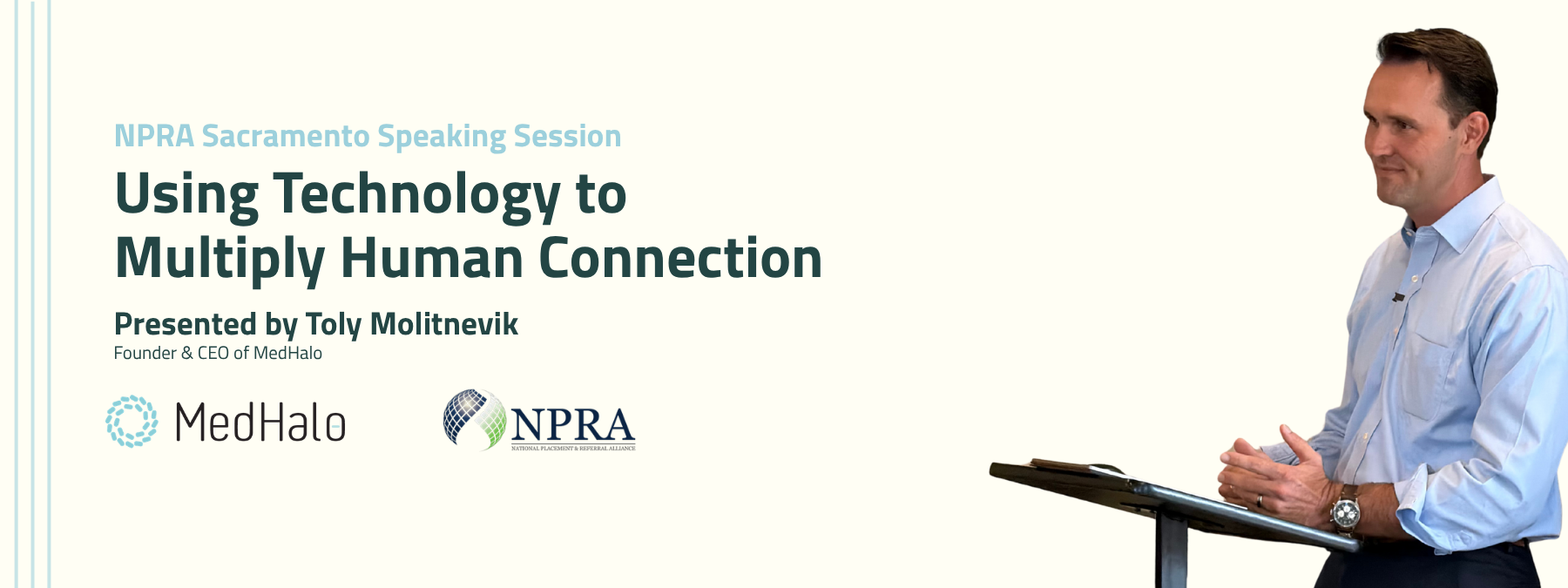
(The following is a transcript from the session)
"Pain as a Gift: Using Technology to Multiply Human Connection"
Opening
Something that served me really well in fifteen years of being an operator is being very soft-spoken. It's not very good in these kinds of contexts, but when we meet with families and we're talking to them — when people ask what's my favorite part of doing what I do — for sure there's building the teams and providing the care, but my favorite part is that moment when a family walks into one of our communities, and they are frazzled, to say the least. They're going through difficulty, usually combined with things going on personally in their lives. Their loved one is going through a significant traumatic experience. They may be in the hospital. They're trying to coordinate care, finances, all of it.
And they come, and whether it's with one of you as an operator or one of you as a placement professional, we get to sit there and tell them and reassure them: what you are going through, we know, and we've been through this many times. We're going to walk through this with you. We're going to figure this out. A good, soft-spoken voice is really nice for that. Building that trust really is what it's all about — that human connection.
And actually, this moment is really going to be the thrust of this talk. You may think you came here to learn about technology. We're going to talk a little bit about that. But it really centers on human connection.
When Maureen asked if I would do a talk on technology, I thought — is that worth the talk? But as I thought about this group, and I've been in this room with you guys, I think there's value I can add. My goal is to share the principles and ideas that led to the innovations we've built at All Seasons, and now to MedHalo. The whole point of this talk is not to talk about the product — it's to give you principles you can walk away with. Because every one of us has work we're doing, and the question is: how can we use technology to be better at the thing we're uniquely good at? Which, hint — is not technology.
I Am Not a Technology Person
Let me tell you a secret. I am not a technology guy. I'm not. Most of us don't geek out on technology. I'm not talking about being excited to set up the next iPhone — I remember when the iPhone came out, one of my roommates was jailbreaking it, black screen, green code, and I thought, I want nothing to do with that. I want technology to just work. I want it to come out of the box and serve me.
I think a lot of times technology promises it's going to make you more efficient, give you more time, and a lot of us have felt lied to, frankly.
[Audience word-association: assistance, safety, fast, convenient, anxiety, disruptive, scary, pet support]
Most people are not early adopters of technology. And I think it's fair to assume the reason you're in this room is because you care about people. So what I want to talk about is a set of questions we can use to evaluate what technology we should be leveraging — what spawns real innovation, even in our own workflows.
The Monday Morning Reality
I sat down with my operations leader and asked her — what, in your perspective, is the difficulty in adopting new technology? She looked at me with a kind smile and said: "Well, I've been up since three a.m. I'm getting back from PTO, trying to catch up on my backlog. One of my leaders is really struggling with a resident we can't figure out. Everyone's showing up, everything's fine. But do you want technology to be the thing that breaks the camel's back?"
The 3 a.m., the backlog, the resident escalating, the day-to-day emergencies — and we want to add a new tool on top of that? How many of you resonate with that — the tool that's going to save you so much time, but you don't even have time to implement the thing that's going to save you time?
That pressure — needing to do so much and not having enough time to do it — is actually where good technology innovation begins. It's where my story starts.
Where It Started
I've been an operator for fifteen years. I started in 2011. My first resident, I was the first caregiver, and I had no experience in caregiving. None. But I remember thinking — how would I want to be treated if I was 91, if I'd had a stroke? He was especially prone to falls. I couldn't stand the thought of him getting up and me not knowing, not being there to prevent the fall. So I went on Amazon and found a driveway sensor to put near him.
Then you add another resident. And another. And a team member who doesn't fully understand the system. You see how that doesn't scale.
One of the things I learned very quickly: you have to choose technology that scales. It has to work for your team, for your organization, not just for you. Somebody once threw me the keys to two more communities and walked away. So we figured out Zoom before COVID, for our Thursday management meetings — still happens, 10 a.m., Thursdays. We built checklists. We built standups, so that if I'm not in the building, the curtains still get adjusted, the lights still go on, the music still plays, without me — because I can't be at four locations at once.
We built a dashboard where teams could compete against each other. Didn't even need prizes — people just got a sense of fun out of it. We gamified it. We built systems in rhythm that brought out the best in people, so our technology would scale. Instead of driveway sensors, we partnered with engineers building wearables, pins, gyroscopes, sensors, and eventually computer vision that could tell us if a resident is in bed, how they're sleeping, their respiration rate — all tracked passively.
I've never coded a day in my life. I don't own a soldering iron. But here's the principle: I wanted to solve pain.
Pain as a Gift
If no improvement is needed — if you have all the resources, all the money, all the time — there's no pain, and you don't need to innovate. Pain is the canary that tells you something needs solving.
Here's an example. We have AI toilets at All Seasons. We do high-acuity memory care, and our residents often can't tell us what happened in the restroom. That matters — cloudy urine or infrequent urination can signal dehydration or a UTI. No bowel movement can mean constipation. And if a community loses track of that, a resident can end up violently agitated, can't explain what's wrong, someone calls the ambulance, they get strapped down, taken to the ER, medicated — because they were constipated. That is significant pain. That's something I never want to happen.
Our original solution: turn off the water to the toilet. Resident tries to flush, can't, complains. Caregiver walks over, turns the water back on, looks in the toilet, flushes it, documents what they saw. Six steps to solve one pain point. High care, low scale.
Then a Harvard student doing a clinical study with Stanford put cameras into the toilet to capture everything. Now every All Seasons toilet runs Truloo by Toi Labs. Six steps became one. It gets documented automatically, and a report goes to our management team.
Technology is not an end to itself. Companies that slap AI onto anything just to sell more — that's not what we want to be doing. The first test of technology: does it solve significant pain? Technology is especially good at things that are repetitive, regularly required, and costly when missed.
We say it at All Seasons: we load the dishwasher fast, so we can sit with a resident slow. Identify what doesn't need a human. That's not high value. Use technology for that.
Four Questions to Ask About Technology
Does it solve significant pain?
Is it regular, ongoing, required, costly?
Can it scale?
Does it return back the most human part of what I can do — my time?
You don't need to be an operator to have pain in your work. Every one of us has pain. One of the easiest ways to find it: be okay with a little complaining. If you catch yourself saying "I have to do this again this week," or "this takes forever, I hate doing this," or "I wish somebody else could just do this for me" — that's a clue. Especially repetitive tasks that eat time.
Using AI as a Knowledge Worker
Most of us are knowledge workers — using our mind, our communication, our judgment, our relationships. AI is especially helpful there. It's one of the greatest opportunities we have to do the thing we're uniquely good at: the people connection.
I used to spend real time on meeting prep — checking notes, searching email, checking LinkedIn for anything worth mentioning. I complained about it. So I went to Claude and explained the problem, walked it through my process, and asked what I could hand off. Now every day, a dossier is waiting in my drafts — what happened last time, what we discussed, the latest update, something important I might have forgotten. That frees me up to do the human connection part.
A quick word on privacy: senior living isn't traditionally regulated like a medical establishment under HIPAA, but privacy and security still matter. We should hold ourselves to a high standard anyway. De-identify health information. Don't put it into a consumer AI tool you're not logged into, where it might train on your data. At MedHalo, we have someone dedicated to privacy and security, and he put together a simple no-IT-department-required checklist for operators — happy to share it after this.
Technology Isn't Just Screens
We had a problem at All Seasons: we wanted more time for resident care. We listed everything a team member does in a day and asked, can technology solve any of this? The answer we found: the floors. Six rooms, carpet and tile, sweep, vacuum, mop — about ten minutes a room, an hour a day. Plus common areas at night.
I remember thinking the Roomba was a joke next to my Dyson. But there's commercial technology now that can clean a building this size automatically — vacuum, mop, refill, dump the dirty water. We piloted it with one team, they loved it, we deployed it.
The math: two hours a day for floor cleaning, times thirty days, is sixty hours. Across six residents, that's ten hours of individualized care bought back per resident. Ten hours. Think about how many walks that is. How many board games. How many unhurried meals. How much earlier you notice a change, just by being more present.
Technology is an opportunity not just on screens, but in physical space too.
The MedHalo Story
Everything I've described — pain, repetitive action, physical space, giving back time — is the ethos MedHalo came from.
[Live demo: Lauren, an experienced medtech, processes doctor's orders and medication intake manually through August Health and paper licensing records — the LIC 622 — while Alicia, a marketing team member with two hours of MedHalo training and zero medtech experience, does the same workflow through MedHalo.]
Last year I was working with technologists on smart glasses with cameras — the idea was real-time guidance for medtechs. During that work, we had a med error. Every community has them. And in that moment of pain, I thought: I wish these glasses could look into this med cup and tell me what's inside it. That was the aha moment. If a phone can identify a plant from a photo, why couldn't it read a doctor's order? Why couldn't it see the pills, transcribe the label, fill out the forms, and — the last step before a resident gets their medication — look in the cup and confirm: yes, that's Mrs. Jones' medication, and yes, I'll document it for you.
The pharmacy problem is real: every community wants to standardize on one pharmacy, but families push back — they don't want to leave the pharmacist they trust. MedHalo doesn't require a barcode. It sees what a medtech sees. It works without forcing families to change pharmacies.
While Lauren worked through the traditional process, AI checked everything behind Alicia in real time — does this doctor exist, is the medication prescribable at this dose, is the provider's license active — then ran it through another layer of checks. Triple-checked.
The math on scale: the average resident takes fourteen medications a day — about four hundred a month. In a hundred-resident community, that's forty thousand medications a month, half a million a year. Apply any error rate to that number and it's a lot of moments where something goes wrong.
Right now MedHalo runs at twenty-five to thirty-five percent of the speed of a human doing manual entry — and it's still faster overall because it's continuous and accurate, not because anyone's cutting corners. It creates a halo — a guardian angel over the med room — and turns med techs who already do excellent work into something like superhuman: it doesn't replace them, it gives them the ability to check and maintain trust that no one has time to do manually.
Our mission: MedHalo on every med cart across the nation and onward. We're building computer vision as the new verification layer to protect residents in communities. The principle hasn't changed since the driveway sensor: use pain to find what technology can solve, so humans can do the thing only humans can do.
The highest use of technology is multiplying the human connection. It hands you back the ability to do the thing that only you can do.
Q&A Highlights
On EMAR integration: Good systems inherently work together. We built MedHalo to integrate with what communities already use — August Health, Alice, ECP — rather than replace it.
On hospitals / Epic: Hospitals have a pharmacy downstairs and use barcode systems like Pyxis or Omnicell — that solves dispensing tied directly to one pharmacy. Senior living never has one pharmacy. One senior living exec told me their company got to sixty percent adoption on a short list of preferred pharmacies, across twelve hundred communities. The other forty percent is family-connected pharmacies — Kaiser, Tricare, others. That's where the mistakes concentrate. MedHalo creates a blanket of safety across all of them, pharmacy-agnostic.
On what MedHalo doesn't do: It doesn't dispense. It doesn't touch the physical pills. It doesn't crush anything. The med tech still does the physical workflow — MedHalo is the verification layer.
On hardware: One unit per med cart. It runs the eMAR — August, Alice, ECP, whatever the community already uses — on the same screen.
On adoption priorities: There are four workflows — doctors' orders, inventory intake and destruction, controlled substance counts, and med pass. Med techs were least excited about med pass, even though it was hardest to build and we started there. They were most excited about intake — "stuff comes in, I scan it, done." So we doubled down on intake for early adoption.
On full-building inventory: One operator told us a full manual pill audit took a person and a half a full week. We think MedHalo can do it in a day — untested, but that's the target.
On cost for small operators: It costs roughly an eighth of a full-time employee's monthly cost. For an operator without a dedicated med room person, that's a small price for a guardian angel over the med room.
On how the product got built: Pain. I was already an informal advisor to a lot of technologists using All Seasons as a testing ground. When the timing came, I talked to several of them, and they wanted in. We dogfood everything — we use it at All Seasons ourselves before asking anyone else to.
Closing line, in response to a small operator asking for more resources like this: "I love that."